Tax Cuts vs. Wealth Taxes: Where Are Homebuyers Heading in 2026?
The Great 2026 Tax Divide: 13 States Cutting Income Taxes While Others Target Wealth
There is a quiet but massive shift happening in state capitals right now, and if you are looking at the housing market through a multi-year lens, the timing could not be more critical.
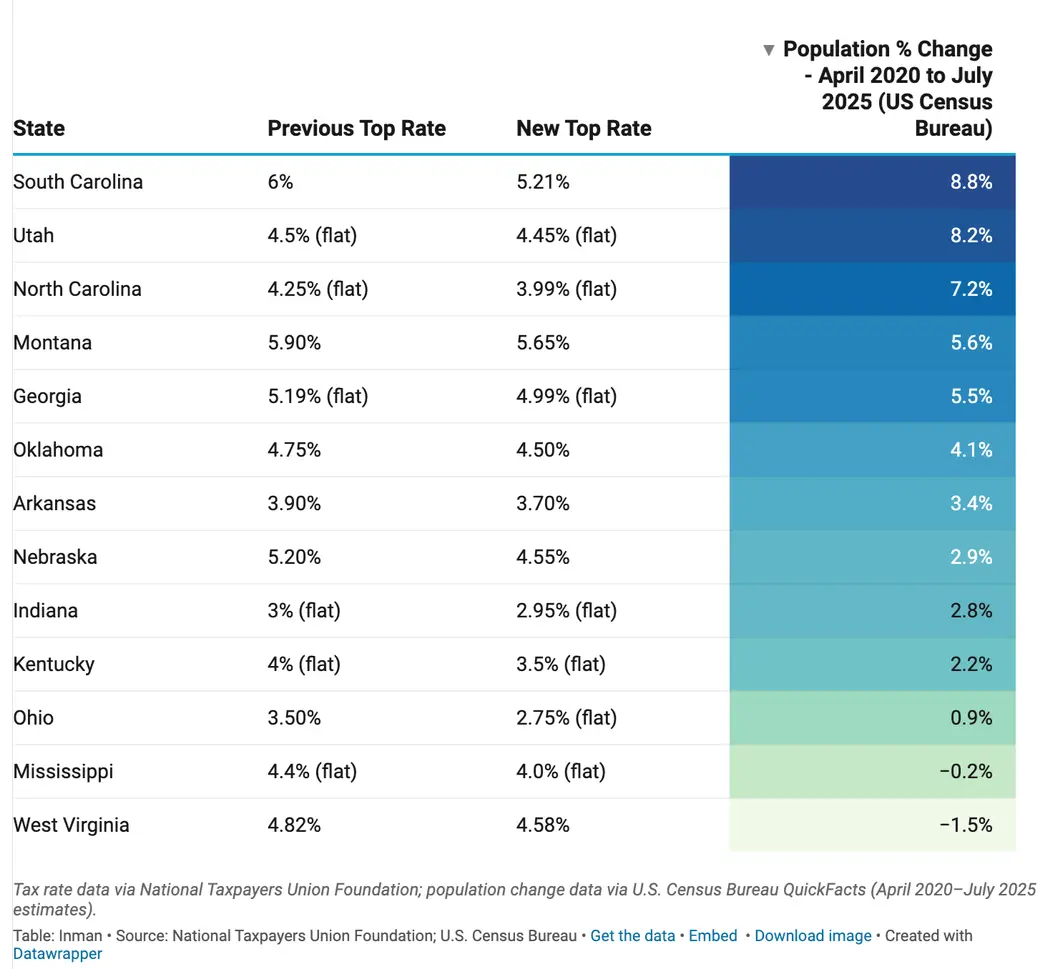
According to a recent analysis by the National Taxpayers Union Foundation (NTUF), 13 states are cutting their personal income taxes in 2026. Arkansas became the latest addition to this list after a special fiscal session dropped its top rate from 3.9% to 3.7%.
In a housing market still hunting for consistent buyer demand, these policy shifts are no longer just lines on a spreadsheet—they are becoming primary structural recruiting advantages.
The 13 States Dropping Income Taxes in 2026
The wave of state-level tax relief taking effect this year spans heavily across the Sun Belt and interior markets. Here is exactly which states are cutting rates:
-
Arkansas: Dropped its top income tax rate from 3.9% to 3.7% in a recent special session.
-
Georgia: Implementing rate reductions, building on its strong appeal to corporate relocations.
-
Indiana: Continuing its steady, multi-year downward trajectory on individual income tax rates.
-
Kentucky: Utilizing a trigger-based mechanism with a long-term statutory path toward zero.
-
Mississippi: Cutting rates despite seeing a slight 0.2% population dip between 2020 and 2025.
-
Montana: Lowering the tax burden after experiencing robust pandemic-era population inflows.
-
Nebraska: Providing tax relief to boost midwestern regional competitiveness.
-
North Carolina: Fueling massive growth hubs like Charlotte with continued tax optimization.
-
Ohio: Executing the most aggressive cut in terms of magnitude, moving from a 3.5% top rate to a flat 2.75%.
-
Oklahoma: Joining the list of states with a formal framework to eventually eliminate income tax entirely.
-
South Carolina: Combining recent income tax cuts with a trigger-based path toward zero.
-
Utah: Shoring up its highly competitive economic landscape with additional rate relief.
-
West Virginia: Pushing ahead with tax cuts and a path toward zero to combat a 1.5% population loss.
1. Businesses Bring Workers; Workers Buy Homes
State tax policy is one of the cleanest inputs for where people choose to live, work, and buy real estate. In an economic environment where affordability remains a dominant constraint on buyer demand, the states that keep take-home pay higher have a clear edge.
More importantly, five of these states—Kentucky, Mississippi, Oklahoma, South Carolina, and West Virginia—have formal, trigger-based mechanisms to further reduce their income taxes over time. This defined path to zero completely changes the calculus for businesses deciding where to plant operations. Corporate relocations bring workers, and those workers buy homes.
Take Charlotte, North Carolina, for example. The city experienced a 10.3% population gain between 2020 and 2025. Unsurprisingly, 2025 marked Charlotte’s best year for corporate recruitment in a decade, securing 15 major projects representing nearly 3,900 new jobs and over $424 million in capital investment.
2. When a Tax Cut Isn't a Growth Catalyst
For real estate professionals, the data requires a nuanced read. A state income tax cut isn't always a rising tide that automatically lifts local real estate demand. Sometimes it is just a marginal tailwind, and other times it is a faint signal in a market struggling with deeper structural issues.
Tax cuts alone cannot override localized economic stagnation or underlying inventory shortages. They amplify existing growth, but they rarely manufacture it out of thin air.
3. The Other Side of the Coin: The Push for Wealth Taxes
While 13 states are actively reducing their tax burdens, major West Coast markets are moving in the exact opposite direction. This widening policy chasm is worth watching closely, as it may accelerate outbound migration.
-
Washington State: Governor Bob Ferguson recently signed the "millionaires' tax" (ESSB 6346) into law. It establishes a 9.9% state income tax on individuals with an adjusted gross income exceeding $1 million per year. The tax takes effect on January 1, 2028, with the first returns due in April 2029.
-
California: Proponents of a high-profile ballot measure ("Save California Health Care and Public Education") successfully submitted over 1.5 million signatures—nearly double the required threshold. This officially lands a proposed one-time 5% wealth tax on billionaires holding more than $1 billion in assets on the November 2026 ballot, aimed at raising an estimated $100 billion to fund healthcare and offset federal cuts.
While Washington still managed a 3.8% population growth between 2020 and 2025, California lost 0.5% of its population over the same period. For agents working in receiving markets (like Nevada, Idaho, or Texas), this means a steady, predictable pipeline of affluent relocation buyers. For agents in high-tax states, it means having candid, strategic conversations with luxury sellers about what high-end demand might look like a few years down the road.
The Real Estate Takeaway: The states moving toward zero income tax are creating a highly visible, modelable environment for long-term business planning. When working with relocation clients or evaluating investment markets this year, remember to look beyond local inventory—the state tax landscape is actively rewriting the maps of housing demand.
Recent Posts